
1.7 Introduction to 2D and 3D
Many years ago, I was introducing a problem in class and I said “of course, this is in two dimensions, so you all know what that means.” A student in the back of the class sighed and said “twice as much work.” That is literally correct. In two dimensions, you will use everything we have learned over the course of Unit 1 Part 1… twice. In three dimensions, you would do everything three times. As we launch into this material, jump back to Unit 1 Part 1 as often as you need to for a quick refresher on how each dimension works individually.
Key Ideas:
Motion in more than one dimension is described by the same concepts and equations that we learned for one dimensional motion.
We can break multi-dimensional motion down into one dimensional “components.” We then apply our equations to those components and reassemble the multi dimensional motion from the results.
In one dimension, a vector was a signed number. In two dimensions, a vector will be two signed numbers or a magnitude and angle.
Three dimensional motion follows the same rules. Vectors will be three signed numbers, or a magnitude and two angles. However, we will not spend time with three dimensional motion in this course.
Important Side Quest: Polar coordinates are another way of expressing pairs of numbers.
Textbook reference: OpenStax College Physics 2e Chapter 3
Expanding the concepts into more than one dimension:
Frame of Reference: Remember from 1.2 that a frame of reference is a necessary first step before we can make any position measurements. Remember, too, that velocity is defined based on position and acceleration is defined based on velocity, so a frame of reference is literally our first move in physics.
Remember, too, that a frame of reference has two jobs. It must define a zero point, and it must define positive directions. In one dimension, this is a simple number line. There is a zero somewhere, and numbers on one side of the zero point are positive, therefore numbers on the other side of the zero point are negative.
If you take two number lines and put them perpendicular to each other, you get a coordinate plane. We still have a single zero point — the origin of coordinates — but this time we have two positive directions. Typically the horizontal axis is positive going to the right and the vertical axis is positive going upward. (Side note: in physics, those axes are sometimes used to graph x and y, but they are just as likely to be used for other variables. Train yourself to think in terms of horizontal and vertical instead.)
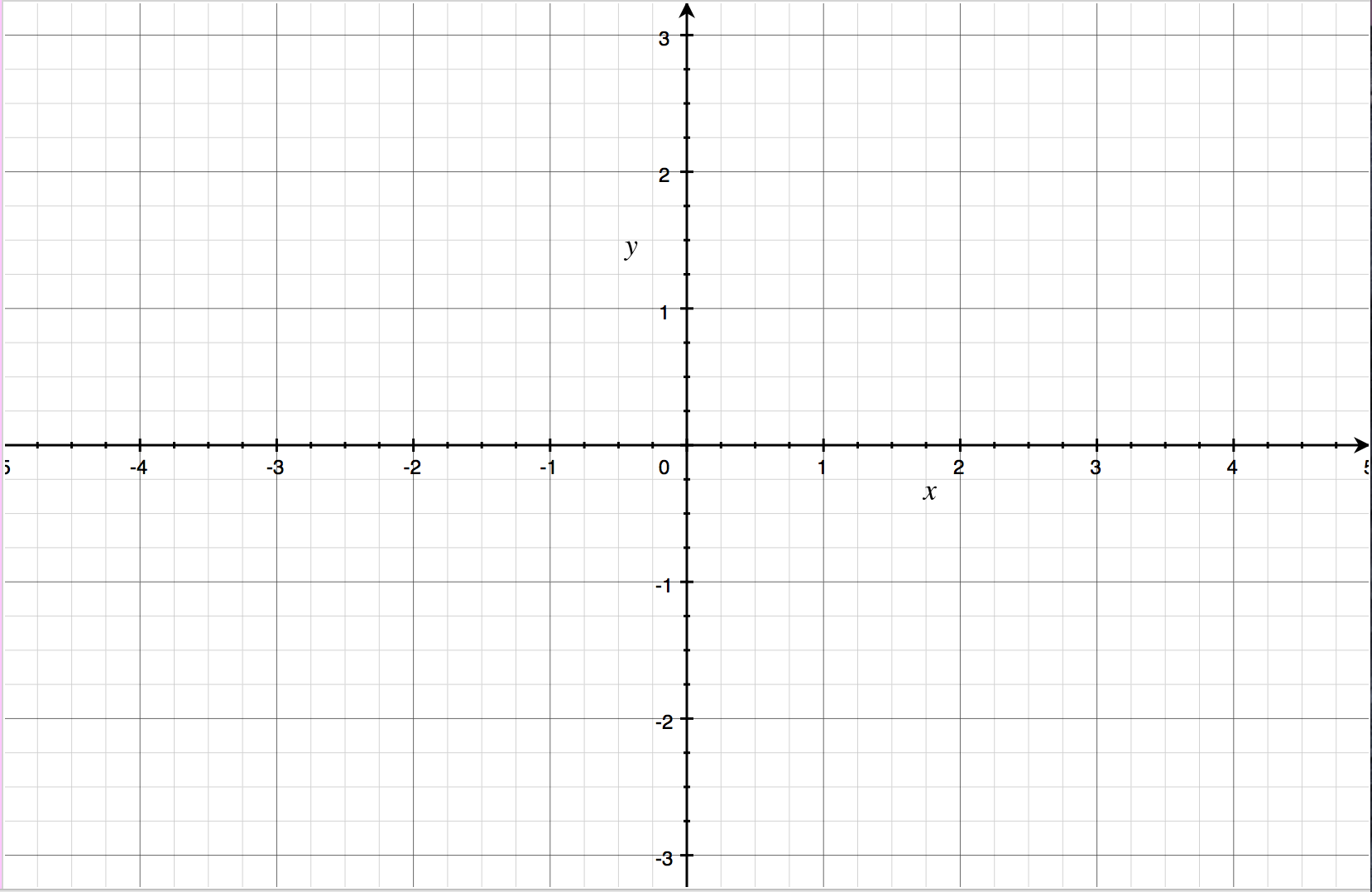
Position: Again, remember the basic definition. Position is a displacement from zero with a sign to indicate the direction. As we move into two dimensions, the position becomes a horizontal distance from zero, with sign, and also a vertical distance from zero with sign. This will be familiar to anyone who has studied algebra. We’re talking about points on a coordinate plane.
That coordinate pair would give the position of an object at some point in time. But you might also remember that we defined an initial position with a zero subscript, the so-called “x naught.” We can do the same thing with a vertical position because — bad joke incoming — y naught? Now we have an initial position pair:
If you’re thinking ahead, you can probably see that this is how we will also define velocity and acceleration in two dimensions. You can probably also see that in three dimensions, we would have a three-number (x, y, z) coordinate. Before we jump into that, however, we need to complete an important side quest. There are two common ways to describe the position of something in two dimensions, and we have looked at one of them. We need to see the other one.
Polar Coordinates:
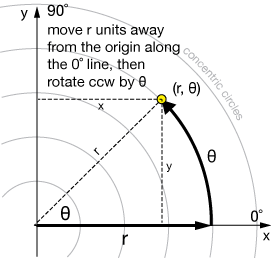
If you take a point on a coordinate plane and you draw a line from the origin to that point, you get a right triangle:
Seriously useful web site: https://www.xaktly.com/MathPolarCoordinates.html
Math web sites almost always use the letter “r” to represent that line from the origin to the point. In physics, you should get used to seeing a letter that corresponds to the vector in question, so typically “r” would be used for a position vector. “v” would be used for a velocity vector, “a” would be used for an acceleration vector and so on.
Also notice that the angle is made with the positive x-axis. Again, this is a normal thing to do in math textbooks, and as usual, physics is going to expand on that a bit. Often, the angle is measured from the positive x-axis, but that is not a guarantee. Remember “words that mean negative” that we looked at in our original vector side quest? In this case, be on the lookout for words that mean the angle in in a weird place. For example, you might see “west of north,” which means that the angle is measured FROM the positive y-axis (“north”) around to the left (towards west, or “west of….”).
Notice that r (or v, a, or whatever other letter is there) is the hypotenuse of a triangle. That means, with a little trigonometry, we can break it down into x and y components. We can also go the other way, and start with the components to find the hypotenuse and angle. Here are the generic equations to convert polar coordinates to rectangular and back again. These equations are based on the math formulation, where “r” is a generic hypotenuse and theta is an angle measured with the x axis.
Polar to Rectangular
A big note of caution is needed here. In fact, several big notes of caution. Here they are:
These formulas are based on the standard mathematical convention that angles will be measured counterclockwise from the positive x axis. If your angle is something else — for example, if you have a compass angle measured clockwise from the positive y axis — you will need to interpret the trig functions to get the right answer. You can either do the appropriate angle addition or subtraction, or you can draw a right triangle to the nearest axes and figure out which trig function applies.
Along the same lines, your trig functions will not always give you negative signs when you need them. Do not take your calculator output at face value. For example, a vector that points into the fourth quadrant must have a negative y component, whether or not your calculator says so.
Going the other way, the r value will be positive, because your calculator cannot return a negative from a square root. However, most calculators will mess up a negative square because of the way that they are programmed. To avoid this, when calculating the hypotenuse, if either x or y are negative, just put them in the formula as positive.
Finally, using the angle formula will return incorrect results about half the time. The reason is that the calculator cannot tell the difference between (-x/y) and (x/-y). It will always return angles that fall between -90 and +90 degrees, even if the actual angle is outside that range.
Putting it all together, conversion from rectangular to polar coordinates is NOT a simple case of plugging it into the calculator and writing down results. Draw out the vector and the axes and use your knowledge of trigonometry to make sure you get the right answer.
End of side quest! At this point, we should be able to find x and y values, which will let us use the math we have already developed.
Velocity and Acceleration:
Looking back at the earlier modules in Unit 1, remember that we defined velocity and acceleration for both x and y. In the case of velocity, it was
Rectangular to Polar
Notice that we have two equations, and to keep them sorted out, we have used x and y subscripts. Get used to subscripts, because you’re going to see a lot of them in the next few pages. Here are the formulas for acceleration
… and again, two equations. It doesn’t take too much imagination to see a third set of equations with z subscripts if we happen to be in three dimensions. That’s for a future physics course, but you should understand that we can expand the framework to cover as many dimensions as we want.
Looking back at equations for constant acceleration, you should realize that any of those equations can be used in the x direction or in the y direction. We just have to put in x components or y components. The important things NOT to do are:
Mix x and y variables in the same equation
Put in a hypotenuse (r, v, or a) in place of a component.
To Do:
Nothing, because this is an introduction, but be sure you feel confident on these concepts.
Section Links:
1.7 Introduction to motion in more than one dimension